
In-Ear EEG, Explained: How Earbuds Read Brain Waves
By the Zone team
· 12 min readUpdated
Last updated: July 21, 2026.
In-ear EEG uses tiny electrodes inside the ear canal to measure the brain's electrical activity. Here is how it works, what it can and cannot tell you, and how accurate it really is.
Key takeaways
What it is: in-ear EEG reads your brain's electrical activity from small sensors that sit inside your ear, with no cap and no wires.
Why it exists: it moves brain sensing out of the lab, so you can see focus and alertness during real work instead of a one-off clinic session.
The honest part: it uses far fewer sensors than a hospital setup and it does not diagnose anything. It is a wellness tool, not a medical one.
What decides quality: fit. A snug, stable seal in the ear is what separates a clean signal from noise.
In-ear EEG is a way to measure your brain's electrical activity using small sensors that sit inside your ear canal. It reads the same kind of signal a clinical EEG reads, just from a spot most people already put something in every day.
Here is the problem it is built for. You cannot see your own focus while it is happening. You find out you drifted only after you have lost an hour, re-read the same paragraph four times, or surfaced from your phone with no idea where the afternoon went. Attention is the one resource you spend all day and can never quite watch in real time.
In-ear EEG is an attempt to close that gap. Instead of guessing how your head is doing, you get a live read on it while there is still time to act. The rest of this guide covers what it actually is, how it works, how it compares to the wired caps you have seen in photos, what it can and cannot tell you, and the myths worth clearing up.
Definition
What is in-ear EEG
EEG, short for electroencephalography, is the practice of reading the tiny electrical signals your brain produces as its cells communicate. For almost a century that meant a cap of electrodes wired to a machine. In-ear EEG takes the same idea and shrinks it into an earpiece. The formal name is ear-EEG, and the concept was first demonstrated by university researchers around 2011 as a way to record brain signals from inside the ear canal.
The pitch is simple: your ear is a stable, private, socially invisible place to hold a sensor, and it happens to sit close to parts of the brain worth listening to.
How it works
Your brain runs on electricity. When large groups of neurons fire in rhythm, they create voltage patterns faint enough to be measured at the surface of your head, in millionths of a volt. EEG sensors pick up those patterns. In-ear EEG places the sensors in the ear canal and the bowl of the outer ear, close to the temporal region of the brain, then filters out the noise to leave a usable signal.
What you get is not a picture or a thought. It is a set of rhythms, waves at different speeds that rise and fall depending on what your brain is doing. Software reads those rhythms and turns them into something plain, like a focus level or a nudge that your attention is slipping.
The sensors and where they sit
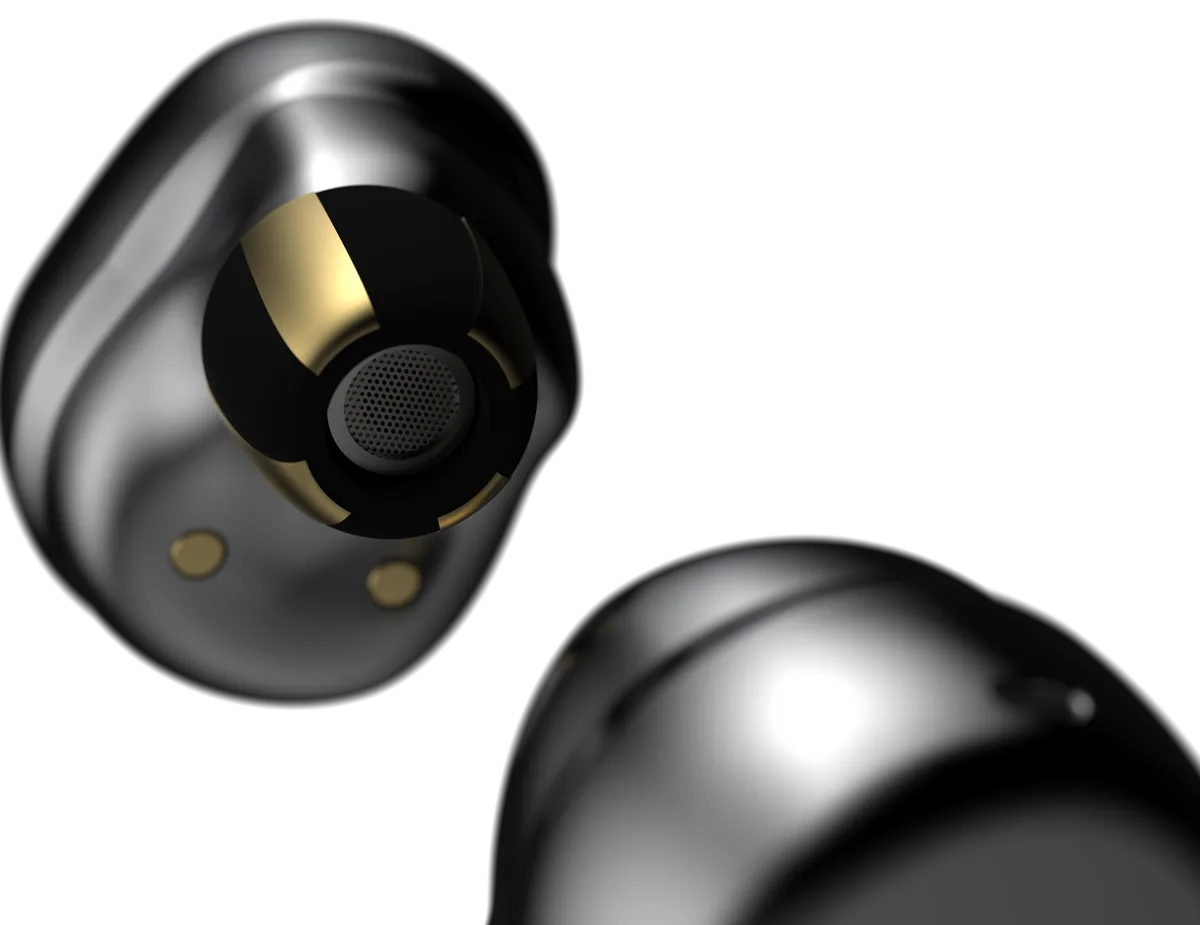
A set of in-ear EEG earpieces looks and feels like ordinary earbuds. The difference is on the surface that touches you. Small contact points, the electrodes, press gently against the skin of the ear canal. Because the ear canal is a snug, enclosed space, it holds those contacts in roughly the same position every time you wear the buds, which is part of why the ear is such a useful spot.
Most in-ear systems use a handful of sensors rather than the dozens on a clinical cap. That is a deliberate trade: fewer sensors, far less hassle, and a device you will actually keep wearing.
Why dry electrodes matter
Traditional EEG needs a conductive gel squeezed onto each electrode to make a clean connection through hair and skin. It works, but it is slow, messy, and cold, and it is the main reason lab EEG stays in the lab. In-ear EEG uses dry electrodes, contacts made from materials that connect well enough without any gel or skin prep.
Dry means you put the buds in and you are recording. No sticky residue, no long setup, no mirror. The tradeoff is that dry contacts are a little fussier about fit and a little more sensitive to movement, which is why the seal in your ear does so much of the work. More on that below.
Comparison
In-ear EEG vs traditional scalp EEG
These two are not rivals so much as tools for different jobs. A clinical scalp setup is built for maximum detail in a controlled room. In-ear EEG is built for real life, worn for hours while you do normal things. Here is how they line up.
| In-ear EEG | Traditional scalp EEG |
|---|---|---|
Setup time | Seconds. You just put the buds in. | 20 to 40 minutes of measuring, gel, and placement. |
Number of sensors | A few, focused around the ear. | 20, 32, or even 64 across the whole scalp. |
Comfort over hours | Designed to be worn all day. | Fine for a session, not for daily life. |
Where it works best | Everyday focus, alertness, and sleep tracking. | Detailed clinical and research work needing full coverage. |
Setup
The gap here is night and day. A scalp cap is a procedure: measure the head, part the hair, apply gel to each site, check every connection. In-ear EEG is closer to putting in headphones. That difference is the entire reason ear-EEG exists, because a measurement you can take in seconds is one you will take often, and frequent everyday data is exactly what a cap can never give you. A recent review of ear-EEG technology frames this wear-it-anywhere use as the field's main promise.
Signal quality
A full scalp cap will always see more of the brain than a few sensors near one ear. That is just geometry. But for the signals near the ear, in-ear EEG holds up better than people expect. One signal-quality study that compared an in-ear device against a conventional cap found the in-ear recordings captured the same core rhythms, especially the ones strongest near the temporal region. The honest summary: fewer sensors, a narrower view, but a real and usable signal for the things it is designed to track.
Comfort
A gelled cap is tolerable for an hour. Nobody wears one to work. In-ear EEG is designed for the opposite: light, dry, and forgettable, so it can stay in through a work block, a commute, or a night of sleep. Comfort is not a luxury feature here. It is what makes continuous, real-world data possible at all.
Measurement
What in-ear EEG can measure
In-ear EEG is good at reading the broad state your brain is in, and less suited to fine detail. Here is what that covers.
Focus and attention
The most useful thing a few ear sensors can track is your level of engagement over time: when you are locked in, when you are drifting, and when you have quietly checked out. It will not read what you are focused on. It reads how focused you are, which is the part you cannot feel accurately in the moment. Seeing that as a simple trend across a work session is where the everyday value lives.
Alertness and drowsiness
The shift from awake to drowsy shows up clearly in brain rhythms, which is why one of the most studied uses of ear-EEG is catching the slide toward sleep. Researchers are actively exploring in-ear wearables for tracking alertness and for sleep monitoring outside a lab. For everyday use, that means the buds can notice the late-afternoon fade before you consciously do.
Brain waves in plain terms
Those rhythms have names, and they are simpler than they sound:
Alpha waves rise when you are relaxed and your mind is idling, and tend to fall when you engage a task.
Beta waves are the busier, faster rhythms tied to active, alert thinking.
Theta waves show up in drowsiness, daydreaming, and light sleep.
Delta waves are the slow, deep rhythms of dreamless sleep.
You do not need to track any of this yourself. The point of the sensors is to do the reading and hand you the plain version: sharp, fading, or resting.
Limits
The honest limits
This is the section most product pages skip. It is also the one worth reading closely, because knowing the limits is how you judge whether any brain-sensing claim is honest.
Movement
Electrical signals from your brain are tiny, and movement creates bigger electrical noise that can bury them. Chewing, talking, walking, even a hard jaw clench can throw movement artifacts into the recording. Good systems filter a lot of this out, but no honest one claims to be immune. In-ear EEG is at its best when you are relatively still, like sitting and working.
Fewer sensors than a lab
A few sensors near one ear cannot see the whole brain. That means in-ear EEG is the wrong tool for anything needing full-scalp detail, and it is not a stand-in for medical testing. It trades coverage for wearability on purpose. Judge it by whether it tracks everyday states well, not by whether it matches a hospital machine.
Why fit matters
Almost every quality problem in in-ear EEG comes back to one thing: fit. A loose contact means a noisy signal, and a noisy signal means unreliable readings. A snug, stable seal is what separates clean data from garbage, which is why good in-ear systems put real effort into ear tips and sizing. If the buds do not sit right, nothing downstream can fully fix it.
Myths
Myths, answered
"It reads your mind"
No. It does not read thoughts, words, images, or intentions, and nothing on the market can. In-ear EEG measures the broad electrical rhythms tied to states like focus and drowsiness. It can tell that your attention is fading. It has no idea what you are thinking about.
"It's a medical device"
No. Consumer in-ear EEG is a wellness tool, not a medical one. It does not diagnose, treat, or monitor any condition, and it is not a substitute for a doctor or a clinical EEG. Reviews of the field are clear that consumer ear-EEG sits apart from validated clinical use. If a product implies otherwise, treat that as a red flag.
"The data is too noisy to be useful"
This one is outdated. Early ear-EEG was a lab curiosity, but the signal-quality work above shows modern in-ear recordings capture real, repeatable rhythms, as long as the fit is good and you are not in constant motion. It is not lab-grade, and it does not need to be. For tracking your own focus and alertness day to day, it is more than enough.
Everyday use
How people use it day to day
Stripped of the science, the daily use is simple: it gives you a read on your own attention that you cannot get by feel.
That looks like noticing you are sharpest in the first ninety minutes of the morning, so you stop scheduling your hardest work for after lunch. It looks like catching the mid-afternoon fade as it starts, instead of pushing through an hour of fake productivity. It looks like seeing that a certain kind of meeting flattens you, or that a short walk actually resets you, because now you have something better than a hunch.
The value is not the brain data for its own sake. It is the small, timely nudge, the equivalent of a friend tapping your shoulder when your focus drifts, so you can adjust while the day is still yours to steer.
Questions
Frequently asked questions
What is in-ear EEG?
In-ear EEG is a way to measure your brain's electrical activity using small sensors inside the ear canal. It reads the same kind of signal as a clinical EEG, but from an earpiece you can wear all day instead of a wired cap.
How does it work?
Small dry electrodes in the ear pick up the faint electrical rhythms your brain produces, and software filters and translates them into a plain readout like a focus or alertness level. Because the ear canal holds the sensors in a stable spot close to the temporal region, it is a reliable place to record from.
Can earbuds really read brain waves?
Yes, within limits. Earbud-style EEG can reliably pick up the broad brain rhythms near the ear, such as those tied to relaxation, active thinking, and drowsiness. It captures fewer of them than a full scalp cap, but the core signals are real and repeatable when the fit is good.
How accurate is it compared to a hospital EEG?
A hospital cap with dozens of gelled electrodes will always capture more of the brain in more detail. In-ear EEG trades that coverage for something a cap cannot offer: comfortable, continuous recording in real life. For the everyday states it is built to track, studies comparing in-ear devices to conventional caps show the signal holds up well.
Is it safe to wear all day?
Yes. EEG sensors are passive, meaning they only listen for the electrical activity your brain already produces. Nothing is sent into your body or your brain. Wearing in-ear EEG is, from a safety standpoint, much like wearing ordinary earbuds.
Can it read my thoughts?
No. It measures the general state your brain is in, like focused or fading, not the content of your thoughts. It cannot tell what you are thinking, seeing, or deciding.
Sources
Ear-EEG. Wikipedia. en.wikipedia.org/wiki/Ear-EEG
The future of wearable EEG: a review of ear-EEG technology and its applications. PubMed. pubmed.ncbi.nlm.nih.gov/37748474
Signal quality evaluation of an in-ear EEG device in comparison to a conventional cap system. PMC. pmc.ncbi.nlm.nih.gov/articles/PMC11420159
In-ear EEG wearables for brain activity assessment and cognitive rehabilitation. Frontiers in Human Neuroscience, 2026. frontiersin.org
Related reading
Read your own focus.
Zone turns focus into a live reading, from inside your ears.
Reserve early access