
Two signals behind every state
Every state comes from two signals Zone measures continuously. Brain Load is Zone's real-time measure of cognitive load, how hard your mind is working right now. Brain Energy is how much capacity you have left. The balance between them is what moves you from flow to fatigue. Both are read from the rhythms in your brain activity, including alpha brain waves. Zone is in limited beta; you can reserve early access.
The five states
The five focus states are not a scoreboard. They describe different balances between effort and capacity, and each one points to a different next move. For every state, here is what the signals show, what it feels like from the inside, what the app suggests, and one honest boundary on what Zone can and cannot say.
State 01 · In Flow · Low load, high energy
What the signals show. Brain Load sits low while Brain Energy stays high: your mind is working at the top of its range without straining for it. Zone reads that balance as your peak performance window.
What it feels like. From the inside it barely registers as effort. The work carries itself, time loosens, and the next step arrives before you go looking for it. You are In Flow.
What the app suggests. The app tells you to protect flow: stay on your current task, avoid context switches, and let the session compound. This is a window to defend, not to optimize.
One honest boundary. Zone cannot manufacture this state, and it will not claim you are In Flow on a schedule. It reports the state when the balance appears, as an estimate against your baseline.
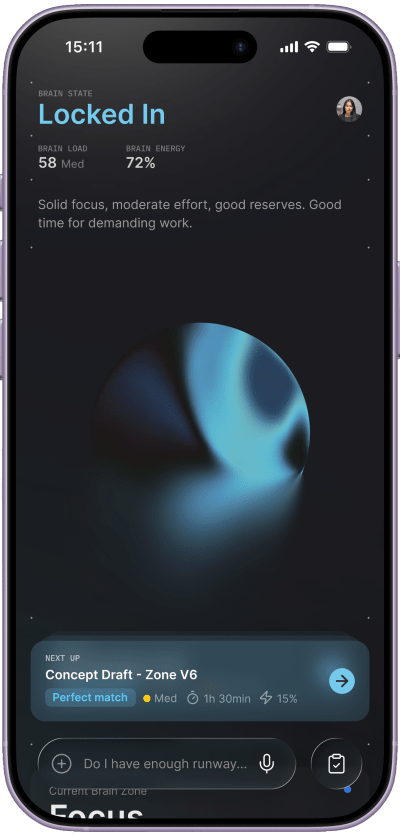
State 02 · Locked In · Effort and reserves in balance
What the signals show. Brain Load is high and Brain Energy is holding: real effort, matched by real capacity. Zone reads the balance between the two and finds it steady.
What it feels like. You feel the work. It is deliberate and demanding, but you have room to push, and the pushing is paying off. This is engaged focus, not the effortless kind.
What the app suggests. The app surfaces the task that fits your current capacity and encourages you to keep going, closing the loops that would pull your attention elsewhere.
One honest boundary. Locked In is not lesser than In Flow, just different. Zone marks the difference so you know whether to push or to protect, but the line between them is an estimate, not a verdict.
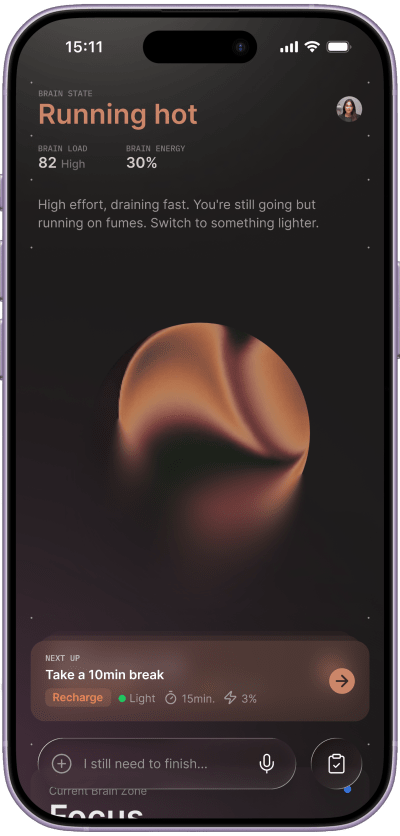
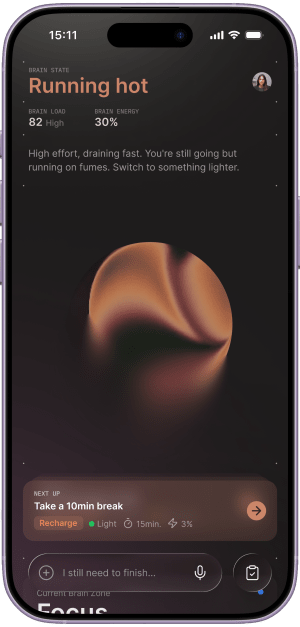
State 03 · Running Hot · Effort outpacing energy
What the signals show. Brain Load stays high while Brain Energy is falling. Zone recognizes when cognitive effort is outpacing your reserves, the pattern that precedes a wall rather than the wall itself.
What it feels like. The work still moves, but it costs more than it did an hour ago. You reread, you force it, small things take longer. You are spending faster than you are refilling.
What the app suggests. Before you hit the wall, the app recommends lighter work or a real break, so you recover capacity while you still have some to protect. We cover the overload version of this in the guide to cognitive overload.
One honest boundary. Running Hot is a trend Zone watches over time, not a single alarming reading. It is a cue to ease off, hedged against your own recent pattern.
State 04 · Drifting · Engagement dropped, energy fine
What the signals show. Engagement falls while Brain Energy holds. Zone detects when your attention begins to scatter, often before you notice it yourself, and reads it as disengagement rather than fatigue.
What it feels like. Your body stayed at the desk and your mind went somewhere else: a memory, a plan, the same paragraph read three times. This is mind wandering, and you are usually the last to know it started.
What the app suggests. Because the capacity is still there, the app nudges you to re-engage: redirect focus, switch tasks deliberately, or grab a quick win before the session loses momentum entirely.
One honest boundary. Drifting is not exhaustion, and Zone draws that line on purpose. It is an estimate that engagement dropped, not a claim about why your mind wandered.
State 05 · Depleted · Reserves bottomed out
What the signals show. Brain Energy has bottomed out. Sustained effort has spent your reserves, and Zone reads when capacity has reached its limit and recovery is no longer optional.
What it feels like. Even easy work feels heavy. Willpower does not help, because the problem is not motivation, it is fuel. This is the state that arrives after the afternoon slump is ignored too long.
What the app suggests. The app stops asking you to push. It points you toward structured rest so you rebuild the capacity your next deep-work block will need. You recover your way out of this one.
One honest boundary. Depleted is Zone's read that reserves are low against your baseline, not a health assessment. Zone is an instrument, not a diagnosis: energy that never recovers deserves a conversation with a qualified professional.
Focus levels vs focus states
A focus level is a single dial, high to low, and it is the wrong shape for how attention actually works. Two people at the same low focus level can be in completely different trouble: one is distracted with plenty of capacity left, the other is out of fuel. A dial cannot tell them apart, so the advice it produces, try harder, is wrong half the time.
Focus states fix that by splitting the single dial into two signals and reading the balance between them. Drifting and Depleted both look like lost focus on a level meter, but Drifting means re-engage and Depleted means rest, and doing the wrong one wastes the hour. That is why Zone reports a state rather than a score. The state carries the instruction; a level only carries a mood.
What sits underneath the states
Underneath every state are Brain Load and Brain Energy, and underneath those is the pipeline that turns raw signal into a reading you can act on. If you want the full path from ear canal to focus state, with the honest limits included, how Zone measures focus walks through it step by step. The short version: the states are estimates against your personal baseline, tracked as trends over time, not clinical numbers. When your reserves are the thing running low, the guide to mental energy covers how the budget drains and refills.
Frequently asked questions
How many focus states are there?
Zone reports five focus states: In Flow, Locked In, Running Hot, Drifting, and Depleted. They are not a ranking from worst to best. Each one describes a different balance between how hard your mind is working and how much capacity you have left, and each one points to a different next move.
What is a focus level?
Focus level is the everyday phrase for how sharp or scattered you feel at a given moment. Zone turns that loose idea into something you can read: instead of a single high-to-low dial, it reports which of five focus states you are in, because being tired and being distracted are different problems with different fixes.
How does Zone know my state?
Zone reads your brain activity through an in-ear EEG array, tracks two signals from it, Brain Load and Brain Energy, and reads them against your own baseline rather than an absolute scale. The states are estimates of that balance, hedged and personal, not clinical measurements or diagnoses.